FITZGERALD, Edward
As Edward Purcell, he was born at the White House, Bredfield near Woodbridge, Suffolk on 31 March 1809, third son of the eight children of John Purcell (25 December 1775–18 March 1852) of Kilkenny, Ireland, and his wife Mary Francis née FitzGerald (1779-30 January 1855) who married on 16 May 1801. John Purcell, on his father-in-law’s death on 6 September 1818, assumed the name of FitzGerald when his wife was reputed to be the richest commoner in England. Edward was educated at King Edward VI grammar school, Bury St Edmund's with his two brothers John Purcell and Peter Slingsby (20 August 1807-13 February 1875) and admitted pensioner at Trinity college, Cambridge on 7 February 1826, and at university he settled into his lifelong dilettante ways, pottering, dabbling, picking up and putting down the classics, water colours, music, poetry, without any system or aim but he graduated B.A. on 23 February 1830. In 1826, the FitzGerald family moved to Wherstead Park near Ipswich. He made lifetime friends with some of his school fellows including James Spedding (28 June 1808–9 March 1881), William Bodham Donne (29 July 1807-20 June 1882), also William Makepeace Thackeray (18 July 1811-24 December 1863) and the poet Tennyson brothers, Frederick (5 June 1807-26 February 1898) and Alfred (6 August 1809–6 October 1892) and studied Persian under (Moses) Edward Byles Cowell (23 January 1826-9 February 1903). He spent the middle part of 1830 in France with his literary friends, spending further time in London as an escort for his mother before returning to the family home at Wherstead Lodge. In 1835 the family occupied Boulge Hall, near Woodbridge and FitzGerald then spent the greater part of his life in the Woodbridge area where his chief friends were poets George Crabbe (24 December 1754-3 February 1832) and Bernard Barton (31 January 1784–19 February 1849), whose daughter Lucy (20 June 1808-27 November 1898) he unhappily married at All Saints’ Chichester on 4 November 1856, separating some eight months after the marriage. His father’s mining venture at Manchester was declared bankrupt in 1848 and in the following year his parents became estranged, with John dying in 1852 and his mother followed in 1855. Edward travelled to the FitzGerald family estates in Ireland and at Naseby, Northamptonshire and spent time visiting his literary friends all over the country. FitzGerald was very keen on yachting and became friendly with a Lowestoft fisherman called Joseph 'Posh' Fletcher (June 1838-7 September 1915). The two men bought a herring lugger named the Meum et Teum but the venture collapsed around 1870 due to Fletcher's alcoholism and FitzGerald's lack of business acumen but FitzGerald remained deeply attached to Posh and continued corresponding with and supporting him through that decade. FitzGerald's first literary work was ‘Chronomoros’ published in Fulcher’s 'Sudbury Pocket Book' for 1841, but his major work was the 'Quatrains of Omar Khayyám', translated from the Persian with the help of his friend and tutor Professor (Moses) Edward Byles Cowell (23 January 1826-9 February 1903), who had married at St Mildred's Church, Helder Grove, London on 23 October 1847 Elizabeth Susan Charlesworth (bapt. 8 July 1812-29 September 1899), a lady with whom FitzGerald himself had considered marriage. After living over a gun-makers shop on Market Hill, Woodbridge, in 1864 he purchased for £710, Little Grange [Farm], Woodbridge and enlarged the building for an additional £1,150 and where he spent the last ten years of his life. Edward Purcell Fitzgerald died on a visit to Merton rectory, Norfolk on 14 June 1883 and was buried on 19 June in Boulge churchyard where he had spent his happiest years at his Boulge Cottage.
Works by This Artist
|
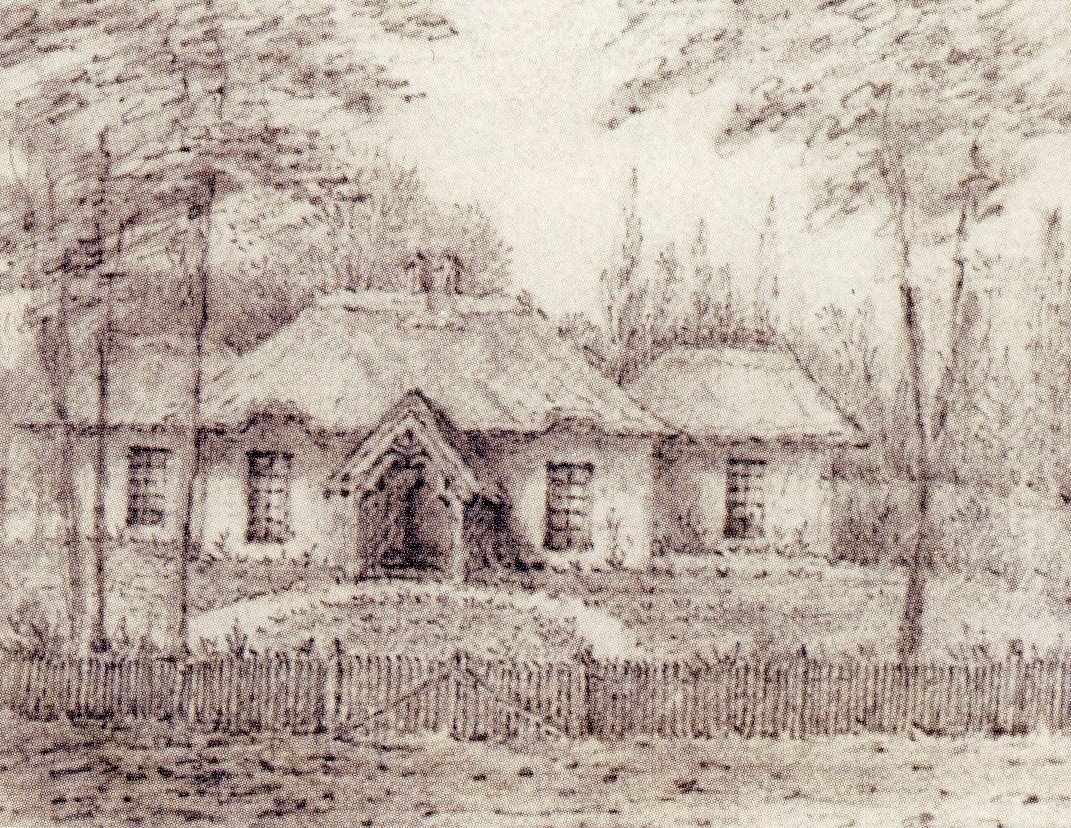
Boulge Cottage, SuffolkPencil sketch
|
|
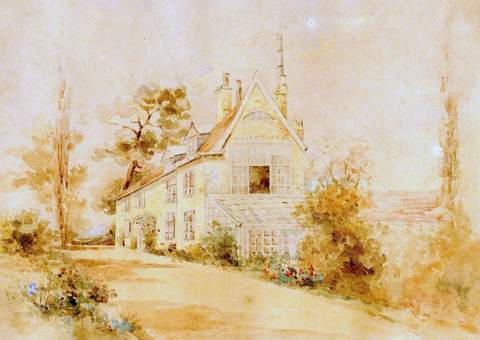
Farlingay Hall, WoodbridgeWatercolour on paper
|
|
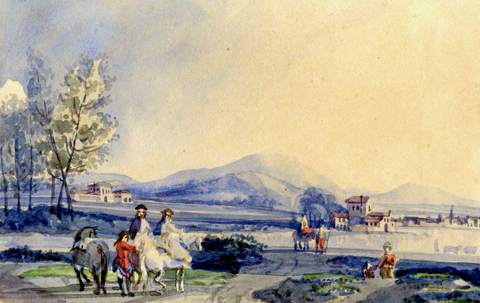
LandscapeWatercolour on paper
|